Folk tales, ballads and legends

Old Tales

Long before the trials, and long after, Scotland told stories of fairy queens, seal wives and women who would not let go. Some are pure wonder. Some were told in court.

Old tale

Janet and Tam Lin

The Scottish Borders, where the Ettrick and Yarrow rivers meet

Janet goes to the rose-wood at Carterhaugh and finds Tam Lin, a young man stolen away by the fairies. On Hallowe’en she pulls him from his horse as the fairy riders pass.

In her arms the fairies change him into a newt, then an adder, then a bar of burning iron. She holds on through every change, until he is free.1
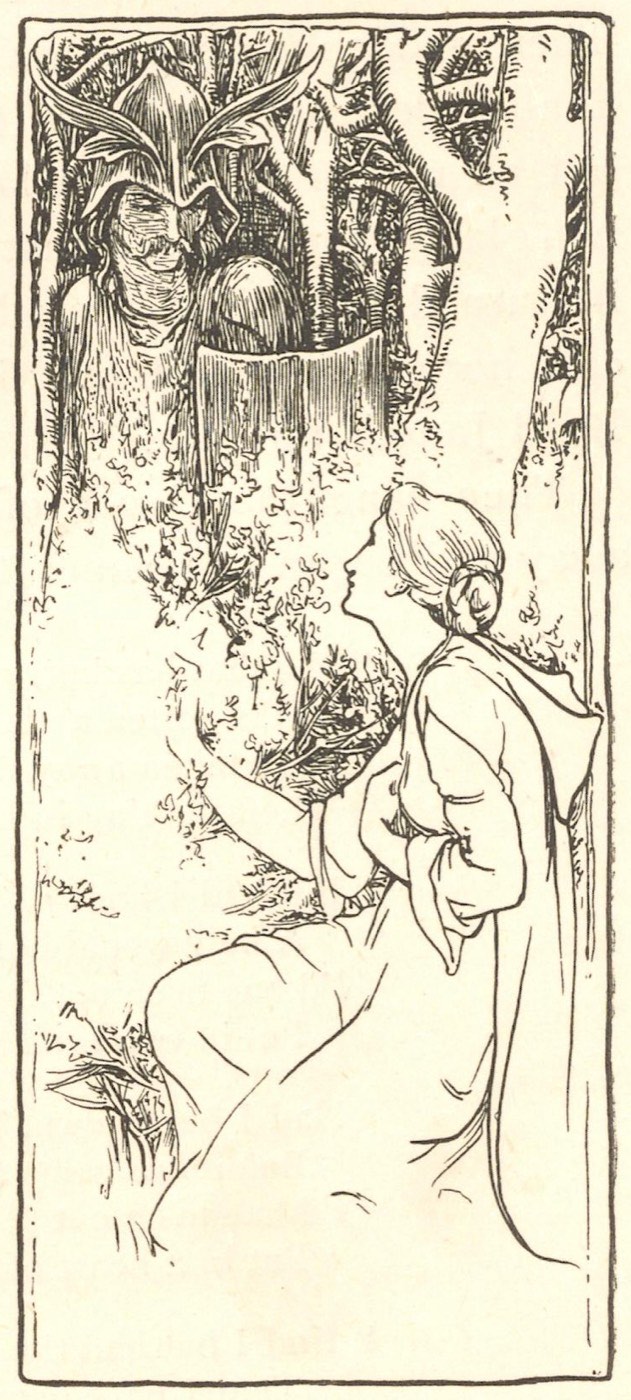
Hold on, as Janet did

Keep holding through every change.

Old tale

Thomas the Rhymer

The Eildon Hills, in the Borders

Thomas lies on Huntlie bank when a lady dressed in green rides down by the Eildon Tree. She is the Queen of Elfland.

He goes with her for seven years, and comes home with a tongue that cannot lie.

One of the finest versions was sung by Mrs Brown, who later lived in Falkland, in Fife.2

Old tale

The seal wife of Unst

Unst, the most northerly of the Shetland Islands

A Shetland man finds a sealskin on the shore and hides it. Its owner, a woman of the sea, cannot go home without it, so she stays and marries him.

Years later one of their children finds the skin. The mother kisses each child goodbye and goes back to the sea.3

Old tale

Kate Crackernuts

Said to come from Orkney, the islands off Scotland’s northern tip

When her stepsister is bewitched, Kate takes her away to seek help. She sits up through the night with a sick prince, follows him to the fairy hill, and, with nuts gathered on the way, wins a cure for him and for her sister.4

From the records

The Queen of Elfame

Ayrshire and Fife

These are not tales but evidence given in court. In 1576 Bessie Dunlop said a ghost sent by the Queen of Elfame, the fairy queen, had taught her to heal. In 1588 Alison Pearson of Byrehill, in Fife, described the fairy court itself.

Both women were condemned. Their visions survive because the court wrote them down.56

Old tale

The Cailleach

The Highlands and Islands

In Gaelic stories the Cailleach, the old woman of winter, ruled the year from Samhain (1 November) to Beltane (1 May). The first snow on the hills was her cape.7

History and legend

St Margaret’s Cave

Dunfermline, Fife

Queen Margaret married King Malcolm III at Dunfermline and was made a saint in 1250. It is said she would slip away to pray in a small cave in the glen below the town.

The valley around the cave was filled in for a car park in 1962.8

History and legend

Black Agnes

Dunbar, East Lothian

In 1338 Agnes, Countess of Dunbar, held Dunbar Castle against an English army for about five months. She was called Black Agnes, it is said, for her dark colouring.

A later chronicle says that when the besiegers’ stones struck the walls, she sent her maids to dust the battlements with cloths, to show how little harm the stones had done.9

Folklore

The Brownie and the second sight

Shetland and the Western Isles

In Shetland, families once believed a spirit called the Brownie helped with their work, and they poured out milk for him through a stone with a hole in it.

Martin Martin, a Skye man describing the Western Isles in 1703, called the second sight ‘a singular faculty of seeing an otherwise invisible object’.10

From the novel

The Fires We Carried begins where tales like these were still believed: Edinburgh, 1591.

The Fires We Carried, Book One

Some stories are still told by candlelight.

Take the road north with you: a free walking map of the witch-trial sites, and first word when Book One is ready. About one letter a month.

By joining you agree to the privacy notice. Leave whenever you like.

Sources and credits

How this site tells history from story

  • From the records what the documents say, with a numbered source.
  • What historians think interpretation by named historians.
  • Folklore belief and tradition, not evidence.
  • From the novel the story, always in gold and kept apart.

Sources

  1. F. J. Child, The English and Scottish Popular Ballads, no. 39, ‘Tam Lin’; earlier in Johnson’s Scots Musical Museum, vol. 5 (1796), sent in by Burns, and Scott’s Minstrelsy of the Scottish Border (1802). Link
  2. F. J. Child, The English and Scottish Popular Ballads, no. 37, ‘Thomas Rymer’, version C, from Scott’s Minstrelsy of the Scottish Border (1802–03), which draws on Mrs Brown’s version (A, c.1800). Link
  3. Thomas Keightley, The Fairy Mythology, ‘The Mermaid Wife’, after Samuel Hibbert, A Description of the Shetland Islands (1822).
  4. Joseph Jacobs, English Fairy Tales (1890), ‘Kate Crackernuts’, from Andrew Lang in Longman’s Magazine. Link
  5. Survey of Scottish Witchcraft, case of Bessie Dunlop (C/EGD/29), citing JC2/1 and R. Pitcairn, Ancient Criminal Trials in Scotland, vol. I (1833). Link
  6. Survey of Scottish Witchcraft, Alesoun Peirsoun (A/EGD/23, C/EGD/34); R. Pitcairn, Ancient Criminal Trials in Scotland, vol. I, part ii (1833), pp. 161–65 (the record’s margin notes ‘Convicta et combusta’). Link
  7. Historic Environment Scotland blog, Ali George, ‘Who is the Cailleach, Scotland’s Ice Queen?’, 16 December 2025. Link
  8. Historic Environment Scotland blog, Samuel Wilson, ‘6 things you might not know about St Margaret’, 6 March 2019. Link
  9. Undiscovered Scotland, ‘Agnes Randolph, Countess of Dunbar’; the chronicles of Andrew of Wyntoun and Walter Bower. Link
  10. Martin Martin, A Description of the Western Islands of Scotland (London, 1703), sections 15 and 18. Link

Pictures

  • Tamlane, from More English Fairy Tales (1894) · John D. Batten · Public domain
  • Kate Crackernuts, from English Fairy Tales (1890) · John D. Batten · Public domain
  • Malcolm and Margaret at Queensferry, mural, c.1899 · William Hole · Scottish National Portrait Gallery · Photo: Kim Traynor · CC BY-SA 3.0
  • Black Agnes, from H. E. Marshall’s Scotland’s Story (1906) · J. R. Skelton · Public domain